Note: This is a feature of The Belvedere Series written by DMV Classical.
Kati Agócs’s horn trio, In Spiritu, which received its world premiere on Sunday afternoon during the Belvedere Series’ season finale at the Louis F. Ryan Recital Hall in Richmond, takes the listener on an absorbing journey from rumination to revelation.
It begins with simple utterances: quiet melodic squiggles from James Sommerville’s horn, matched by whispery sul ponticello playing by violinist Dominic Salerni, with pianist Ingrid Keller playing furtive phrases in the silences between. (As founder and artistic director of the Belvedere Series, Keller not only performed the premiere but also commissioned the work — more info in the preview article I wrote.) Agócs cited Béla Bartók’s “night music” as an inspiration, and the first movement, titled “Night Vision,” sounded almost like a forest at dusk, when frogs croak, birds sing, and crickets chirp to create a soundtrack both beguiling and unintentional.
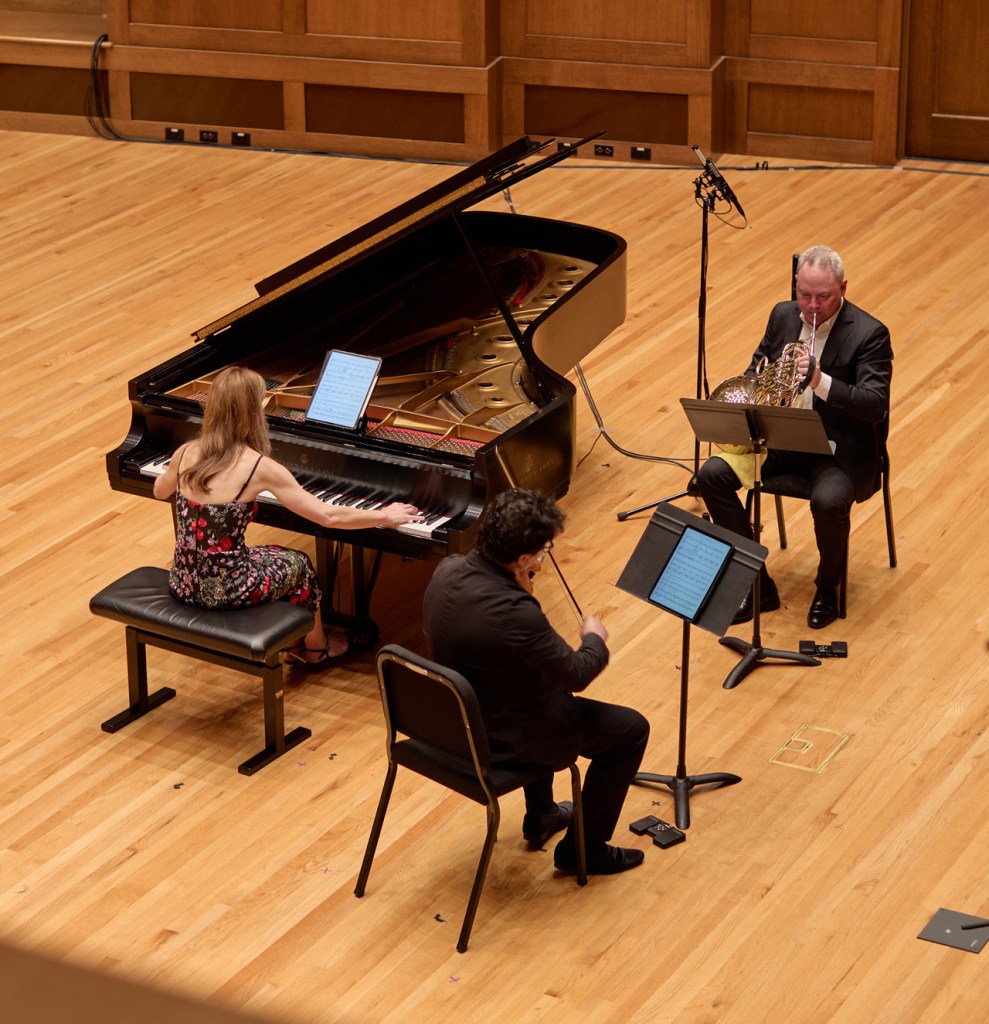
In the second movement, “Anachromie,” the chord progressions suggested by the music of the first movement seemed to be feeling around for a direction, making progress for a few measures, then taking another turn. At times, one wondered where exactly this was going, but Sommerville (former principal horn of the Boston Symphony), Salerni (a member of the Attacca Quartet), and Keller played with a keen spontaneity that rewarded patience.
Advertisement
The harmonic progression dissolved into pure aural gesture in the third movement, “Reverse Reverb,” with Keller’s piano even more abstract, and Salerni almost exclusively playing super-high or sul ponticello before dissolving into pure toneless scraping (on purpose — he made it sound good). This led into Sommerville’s cadenza, stark and enigmatic yet with a full, rounded tone that was a treat in itself. Keller kept the sustaining pedal depressed during the cadenza, and the piano’s strings vibrated with ghostly echoes.
It was in the final movement, “Sublimatum,” that all the gestures and phrases in the preceding three finally coalesced, like a mist settling on a surface and becoming a rivulet of water. A gorgeous hushed melody, rapt as a lullaby, evolved into a heroic register. The instruments no longer seemed to be talking past each other, but playing together; the music had a clear direction, pointed towards the infinite. Quickly after reaching a climax, it evaporated again, but the catharsis was profoundly satisfying.
So: A big kudos to Keller for commissioning this work, and to her, Sommerville, and Salerni for bringing it to life so vividly. It would be enlightening to listen to this trio again with its closing moments in mind, and fortunately this group will record it for eventual release in a commercial compilation of Agócs’s works.
The program began with Ernst von Dohnányi’s second piano quintet, performed by Keller with violinists Nathan Meltzer and Siwoo Kim, violist Milena Pájaro-van de Stadt, and cellist Joshua Halpern. Completed in 1914, making it by far the oldest piece on Sunday’s program, the quartet’s unusual key of E-flat minor, which has six (count ‘em, six) flats, gave it dusky tone colors and lots of opportunities for harmonic ambiguity. Some melodies in this quartet are not particularly ear-catching, but in a performance this taut and alert, the harmonies themselves hit you in the gut.
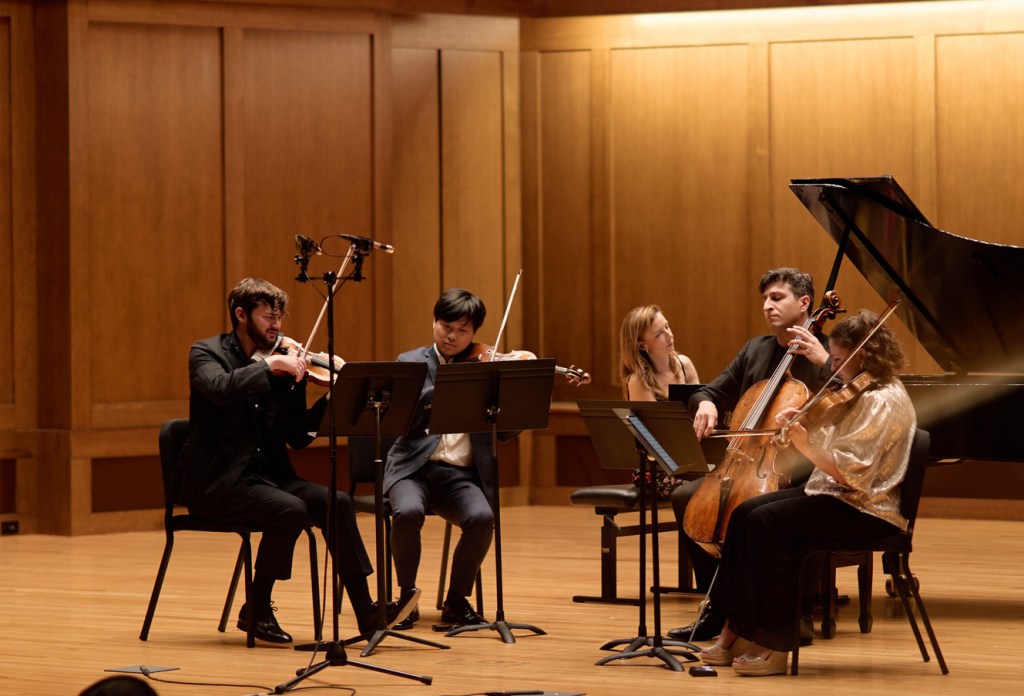
The best textural effect comes in the opening measures, with severe chords in the strings and ominous rumblings in the piano, and it was certainly arresting on Sunday. The quartet pressed on to a big climax, Keller urging them on, before Pájaro-van de Stadt gave a ruminating feel to a solo that seemed to unwind the tension. The Intermezzo second movement had some actual wit, with Pájaro-van de Stadt bumping a catchy melody along in a triple meter; it was subjected to increasingly harsh variations until Keller plopped down a big dissonant chord that hung in the air for a while before everyone decided to ignore it and go back to the original theme.
Advertisement
Dohnányi combines a slow movement and a finale, opening with some severe music in the strings and no piano at all, before reprising the opening rumbling and the subsequent theme, playing on the line between minor and major and creating excruciating harmonic tension that resolved to the major, first tentatively and then decisively. The string players sounded like a unified quartet throughout, and it was a treat to hear Keller’s thoughtful playing, shifting from support to partner to lead as the music demanded.
The romantic largeness of Dohnányi led ideally into the spare utterances of the Agócs horn trio’s opening, and the ecstasy of the trio’s close made an apt transition to Olli Mustonen’s second nonet. Violinist Isabelle Ai Durrenberger, violist Lauren Spaulding, cellist Gabriel Cabezas, and bass Sam Suggs joined the string players from the earlier pieces to make two string quartets plus double bass.
Mustonen’s nonet, premiered in 2000, practices one of the best kinds of minimalism, where a rhythm or phrase the composer likes gets refracted endlessly until it acquires the status of mythic utterance. The best part, in my opinion, is the third movement, where a ripe phrase reminiscent of the “Heilege Dankegesang” part of Beethoven’s String Quartet no, 15 ends up both luminous and mysterious. This group found the balance between chamber intimacy and big-ensemble power, incisive in the rocking rhythmic pattern in the opening movement (marked “Inquieto”) and successfully launching the rocket-ship Vivacissimo finale, which rivals the finale of Felix Mendelssohn’s octet for strings in sheer energy and exuberance.
This program took three big swings and made them pay off. Sunday afternoon’s concert took place in Richmond but would have been an impressive achievement anywhere. It will be fascinating to see where Keller takes the Belvedere Series from here.
MARGINALIA
I went a bit long with this review, and yet, there are still notes I wish to make.
- Sommerville opened the third movement of Agócs’s trio by removing his mouthpiece and blowing air into the instrument to make a whooshing noise that the composer said was intended to evoke an effect in “When the Levee Breaks.” Agócs invoking Led Zep was a good reminder that, unlike some classical music fans, classical composers and performers typically listen to and enjoy popular music.
- The hall (part of a fancy-looking private school) is very nice — extremely high ceilings, which provided plenty of space for this program to be loud, but not so echoey that internal textures were obscured. I was impressed to see it at least three-quarters full. Evidently Keller’s statement that she has a group of enthusiasts who trust her enough to go where she leads is no idle boast.
- Richmond is pretty cool. (I had not been there before, except to drive around it on the way to points further south.) I quite enjoyed hiking Belle Isle, running near Tobacco Row and by the James River, and visiting the Poe Museum. We were not there for too long, and I understand there may be additional things to do there. However, both going down and coming back, we passed accidents on I-95 in which at least one motor vehicle was completely totaled and either actively on fire or recently extinguished, which kind of takes the shine off driving there again. Still, with programs like these…